 English
 Español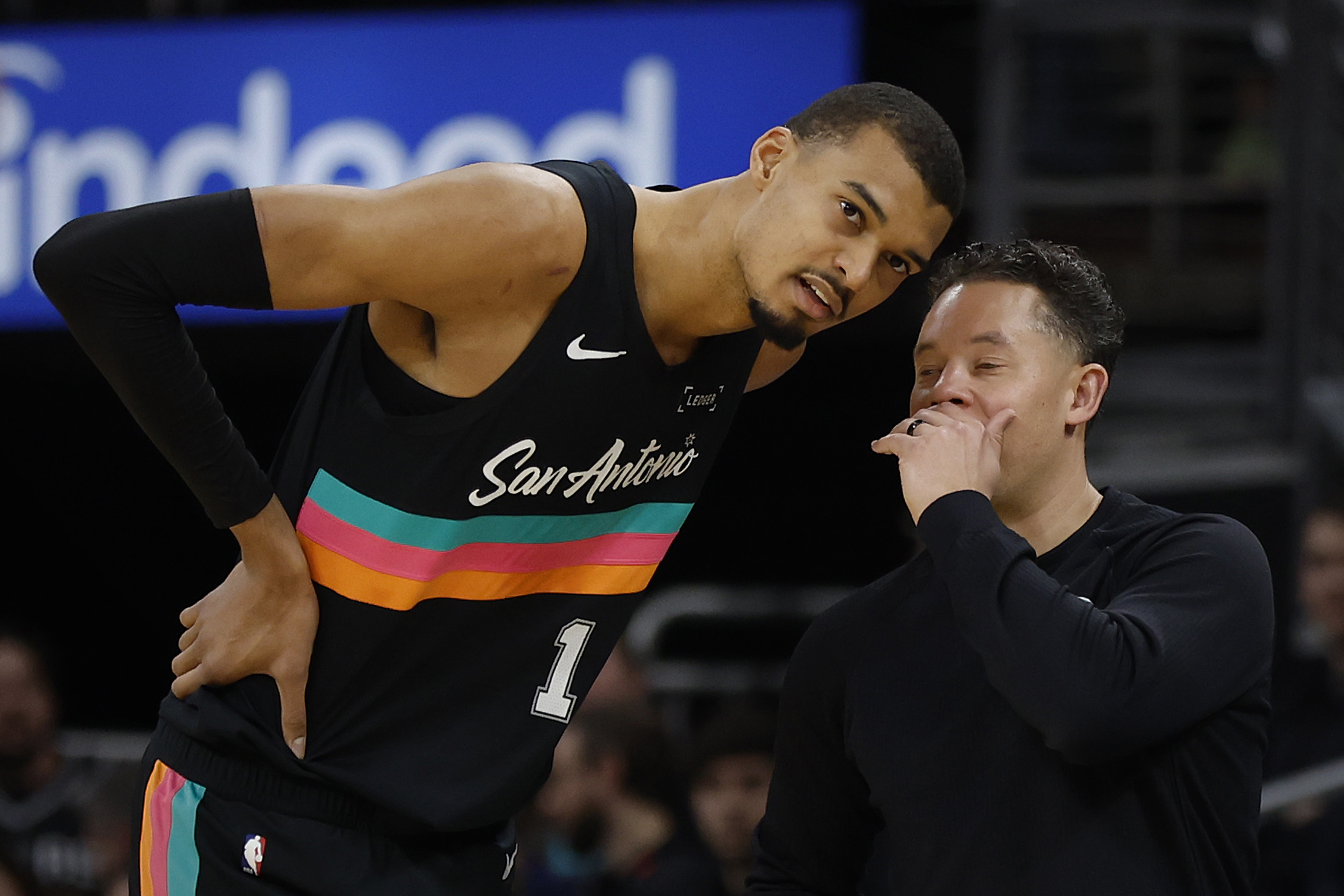
After cruising past the Brooklyn Nets on Thursday to finish February without a loss — just the third perfect month in franchise history — the San Antonio Spurs have now won 11 straight games. That’s the longest active winning streak in the NBA and just the third double-digit roll in the league this season.
The other two teams to rip off at least 10 straight W’s in 2025-26 are the teams leading their respective conferences: The Detroit Pistons, whom the Spurs knocked off in impressive fashion earlier this week, and the defending NBA champion Oklahoma City Thunder — who, as you might recall, have had more than their fair share of problems with San Antonio this season.
Those problems now include objects in the rear-view mirror being closer than they appeared. Between San Antonio’s surge and Oklahoma City hovering just above .500 over the last month and a half amid a raft of injuries — including, most notably, to MVP frontrunner Shai Gilgeous-Alexander, who’s about to return to the fold — the Thunder’s lead over the Spurs for the West’s No. 1 seed is down to just 1.5 games, with San Antonio holding the head-to-head tiebreaker.
“After the All-Star break, we had the conversation with the team of just, every game from now on, it means something,” forward Julian Champagnie recently told reporters. “We’re fighting for something. We’re building something.”
Ahead of a marquee nationally televised Sunday matinee matchup against the New York Knicks — the team that beat them in the Emirates NBA Cup final back in December — here are 11 things worth knowing about the NBA’s hottest team, one for every win in the streak, starting with the literal and figurative biggest reason for the Spurs’ rocket-ship rise back to title contention:
1. Victor Wembanyama’s been ridiculous
Like, even for him.
The big fella’s averaging 22.5 points, 11.3 rebounds, 3.5 assists, 3.5 blocks and 1.4 steals in 29.3 minutes per game during the winning streak. He’s been a force down low, shooting 67% in the lane, scoring 1.22 points per paint touch and averaging nearly eight free-throw attempts per game. And, as ever, what he does on offense isn’t even half the story.
Wembanyama has blocked 38 shots during this winning streak — as many as, or more than, six teams in that span (Dallas, Phoenix, Golden State, Brooklyn, Indiana, Denver). And his impact extends to plenty of shots he doesn’t get, too: Opponents are shooting just 46% on 2-point shots with Wembanyama on the floor during this stretch, according to PBP Stats — more than six percentage points below what the NBA’s worst inside-the-arc-shooting offenses have managed during the full season.
The Spurs have outscored opponents by a whopping 179 points in the 323 minutes Wembanyama has played during the streak — far and away the highest plus-minus in the NBA in the month of February. That averages out to plus-25.9 points per 100 possessions, with San Antonio scoring like the best offense in the NBA and allowing a mere point per possession in his minutes.
Whether he’s incinerating an opponent to the tune of 40 points in three quarters, like he did to the Lakers, or mitigating a down shooting night by simply suffocating them, as he did to the Raptors in the fourth quarter on Wednesday or the Nets on Thursday, the sheer geometry- and probability-warping power of how Wembanyama deploys his dimensions necessarily makes every game he appears in about him. That kind of gravity has a way of bending outcomes in your direction; when Wemby’s on the floor, performing like this, things seem to go the Spurs’ way a whole hell of a lot.
Especially considering he’s got help.
2. Strength in numbers
No Spur is averaging more than 30 minutes per game during the winning streak. Seven Spurs are scoring in double figures; an eighth, veteran forward Harrison Barnes, is kicking in 9.2 points in 22.8 minutes per game, shooting 41.8% from 3-point range on just under five attempts per contest.
Wembanyama’s clearly the supermassive star around which the entire system revolves, but there is a system at work here. It’s a simple idea, one pounded into the heads of countless Spurs over the decades like the stonecutter’s hammer pounding into that proverbial rock: “point-five basketball.” Within a half-second of getting the ball, you need to be shooting it, passing it or driving it, putting perpetual pressure on the defense in the never-ending battle to turn a good shot into a great one.
It’s working:
For the season, San Antonio ranks 11th in the NBA in offensive possessions per game finished following a dribble handoff, 10th in drives to the basket per game, and eighth in trips that end with a spot-up shot. (Conversely, the Spurs are just below league-average in how frequently they attack out of isolation.) Only seven teams average fewer dribbles per touch, and only nine have a shorter average touch time. The ball doesn’t stick, which means everybody’s a live threat, which keeps everybody engaged, because it can be anybody’s night.
During this winning streak, San Antonio trails only Cleveland in offensive efficiency and leads the NBA in assists per game and points created via assist, while also sitting third in secondary or “hockey” assists — a.k.a. the pass that leads to the pass that leads to a score — with the 11 wins featuring six different players (Wembanyama, Devin Vassell, De’Aaron Fox, Stephon Castle, Keldon Johnson, Julian Champagnie) leading the team in scoring on the night.
Many hands make light work. The Spurs have had plenty of that recently, thanks in part to …
3. … a pretty kick-ass new starting five
When sixth-year swingman Vassell, who’d missed 13 games with an adductor strain, returned to the lineup at the end of January, Spurs head coach Mitch Johnson shuffled up his starting five. Vassell went back, joining Fox and Castle in a three-guard look, with Wemby in the middle and the sweet-shooting Champagnie at power forward.
So far, so good. The Spurs are now 9-1 in games started by that lineup, which has outscored opponents by 31 in 101 minutes in those 10 games. That quintet has scored a scorching 126.3 points per 100 possessions, blitzing the opposition by 13.2 points-per-100 — an elite net rating befitting one of the league’s elite teams, fueled by …
4. … three-guard lineups!
Hey, remember when folks were worried that, after trading for and maxing out Fox, with Castle coming off Rookie of the Year honors and in line for a bigger role in Year 2, with Vassell in the mix as a core rotation piece off the ball, and with No. 2 overall pick Dylan Harper about to work his way into the conversation, the Spurs might have too many mouths to feed in the backcourt? Turns out they were fine!
For the season, three-guard lineups have been really damn good for San Antonio. Whenever any three of Fox, Castle, Vassell and Harper have been on the floor, the Spurs have outscored opponents by 109 points in 569 minutes — which works out to 9.3 points-per-100 — and have averaged 29.5 assists per 100 possessions, which would lead the league for the full season.
The positional size of the Spurs’ guards — Fox stands 6-foot-3 with a 6-foot-6.5-inch wingspan, Castle’s 6-6 with a 6-9 wingspan, Vassell’s 6-5 with a 6-10 wingspan, Harper’s 6-5 with a 6-10.5-inch wingspan — helps mitigate the typical defensive concerns that might come with rolling three-guard looks. (So, too, does the looming back-line presence of Wembanyama — and, for that matter, reserve center Luke Kornet, who’s been aces in his first season in Texas.) And the offensive benefits of virtually always having multiple high-level ball-handlers capable of attacking the rim, moving without the ball and facilitating on the go have far outweighed any of those drawbacks.
Whether that stays true in the playoffs remain to be seen, particularly if Fox (35.1% from 3-point land), Castle (29.3%) and Harper (25.4%) are unable to consistently cash in on the long-distance opportunities they’re likely to get from postseason defenses hell-bent on packing the paint to limit Wembanyama. Thus far, though, the Spurs have found themselves very much enjoying having too much of a good thing.
5. They’re hitting the gas
One thing you can do when you got all them guards: run.
PUT 'EM IN THE DUNGEON 😱 😤
— San Antonio Spurs (@spurs) February 27, 2026
📺 @FanDuelSN_SWpic.twitter.com/7nEHEU3bM0
The Spurs, for decades everybody’s least favorite half-court science-class frog dissection (no matter how much Mobb Deep the marketers applied), get out in transition at the league’s fifth-highest rate, according to Cleaning the Glass. They rank third in points added per 100 possessions by pushing off a live rebound and ninth in fast-break points per game, consistently hunting opportunities to hit ahead and hit the gas.
(They’re also seventh in the NBA in points scored per half-court possession. Cue up the Mobb Deep.)
6. They’re winning the possession battle
Over at Last Night in Basketball, Jared Dubin tracks the nightly possession battle — which teams do a better job than their opponents of controlling the offensive glass, free-throw line and turnovers, and which ones struggle with it. The Spurs are tied for fifth, according to Dubin, generating 2.6 more possessions per game than their opponents, on average. (The only teams ahead of them: Detroit, Houston, Miami and New York.)
Last year, the Spurs turned the ball over at the NBA’s 10th-lowest rate; this year, they’re up to fourth. Last year, they ranked 21st in offensive rebounding rate; this year, that’s up to 13th. Last year, they were 24th in how often they got to the free-throw line; this year, they’re eighth. And last year, they cleaned the defensive boards at a bottom-five rate; this year, only the Charlotte Hornets are allowing offensive rebounds less often.
If you’re a team without elite shooting all over the floor, you’d better find ways to give yourself more opportunities to score than the other guys. The Spurs have gotten better at controlling what they can control in the possession game virtually across the board — a massive reason why they’ve taken such a quantum leap up the standings.
7. Real quick: Stephon Castle rules
I already gushed about the sensational sophomore a couple of months ago, so I won’t belabor the point. I’ll just note that guards this big, nasty, physical, quick and generous — he’s just outside the top 10 in assists on both 3-pointers and baskets at the rim, according to PBP Stats — don’t exactly grow on trees. I can’t wait to watch this dude in the playoffs.
random stephon castle offensive rebound compilation pic.twitter.com/KsNACjSVBu
— awday (@awday319) February 27, 2026
Spurs opponents, I suspect, don’t share my excitement.
8. De’Aaron Fox can bend time
Everybody: freeze.
That’s just filthy … and frankly, given how fast Fox can be with the ball in his hands, kind of unfair.
By the way: While Fox’s nightly numbers — 19.2 points, 6.3 assists and 3.8 rebounds in 31.6 minutes per game — are down this season, his assist rate’s up, he’s posting the second-highest true shooting percentage of his career, and he’s still eminently capable of taking over a game:
Wembanyama understandably gets the headlines, and Castle and Harper have generated well-deserved praise for how well they’ve hit the ground running. But Fox merits his fair share of the credit for San Antonio’s success, too; he’s been exactly what the Spurs hoped he’d be when they air-lifted him out of Sacramento last season, a perfect plug-and-play No. 2 option capable of helping elevate a precocious team to postseason readiness.
9. Everybody needs a Julian Champagnie
Champagnie went undrafted out of St. John’s in 2022. He caught on in Philly, signing a two-way with the 76ers, but was on the outside looking in for a 54-win Sixers team and wound up getting waived after the trade deadline. The rebuilding Spurs quickly scooped him up, gave him some actual minutes … and found out that he could shoot a little bit.
Julian Champagnie tonight:
— Bala (@BalaPattySZN) February 27, 2026
• 26 PTS, 2 BLKS, 6/9 3PM, 10/14 FG pic.twitter.com/VrowFu2jl0
Fast forward three years, and the 24-year-old has established himself as a real piece in San Antonio — a bona fide starter, a 6-7 combo forward who rebounds bigger than his size, who moves the ball quickly and smartly, who defends across the frontcourt spots energetically and effectively, and, most importantly, who consistently knocks down 3s.
Champagnie is fourth in the NBA in catch-and-shoot 3s, behind only Kon Knueppel, Donte DiVincenzo and Nickeil Alexander-Walker. He’s shooting 38.9% on those spot-up looks, and has been as effective above the break as in the short corners, making him a valuable chess piece for Johnson to move around the floor. (It’s notable the Spurs score 8.2 more points-per-100 with Champagnie on the floor than off it — the biggest offensive on/off swing of any Spurs rotation player.)
He’s also a perfect fit for that point-five style, ranking in the 99th percentile in the NBA in quick decision-making rate — a stat tracked by The BBall Index measuring the share of a player’s touches that last fewer than four seconds. Among 241 players who have played at least 20 games this season and are averaging at least 20 minutes per game, Champagnie is tied for the eighth-shortest average touch time, according to Second Spectrum — just 1.44 seconds per touch.
Wings with size who can shoot, rebound and defend, who are comfortable getting off the ball quickly and playing a lower-usage role, can be both difficult to come by and worth their weight in gold for a team that’s trying to fill in the gaps around its star-level shot-creating talent. The Spurs found one on the scrap heap, gave him an opportunity, and locked him down for $12 million over four years. Pretty decent bit of business!
10. Keldon Johnson’s in his sweet spot
It could be a tough hang, sometimes, during those years when Johnson had to be one of the best two or three players on those bad Spurs teams — a player capable of scoring 20 a night, but overtaxed in a role that demanded he shoulder too big a workload. On a San Antonio squad with more marquee talent and shot creation at the top of the roster, though, Johnson has slid comfortably into a role as a veteran sixth/seventh man who can come into the game and just let it rip:
In a more circumscribed role, the 26-year-old Johnson is playing arguably the best ball of his seven-year NBA career, averaging 13.2 points, 5.6 rebounds and 1.4 assists in 23.5 minutes per game off the bench. He’s shooting a career-best 62.1% on 2-point shots and 38.3% from beyond the arc, grabbing rebounds at a career-high rate, and seemingly really enjoying life as a guy who knows his role is Move Fast and Break Stuff.
Johnson can slot into a complementary role alongside Wembanyama, Fox, Castle and Co. in mix-and-match lineups, or act as an attacking hub in second-unit groups, adept at attacking closeouts and making bowling-ball drives into the teeth of the defense to finish up close. The Nets — who, in fairness, are not good — didn’t know what to do with him in the first half on Thursday, as he repeatedly worked his way into the paint for easy-money half-hooks and drop-step finishes off glass.
San Antonio’s position near the top of the standings will likely result in Johnson getting a fresh look as a potential Sixth Man of the Year candidate. Good. He deserves that kind of consideration, and some recognition for being willing to see a bump down the offensive pecking order not as a demotion, but an opportunity to shine bright as a star in a new role.
11. Their résumé is legit
The Spurs haven’t gotten to within arm’s reach of the West’s top spot just by fattening up on the league’s lower lights. They’ve played one of the league’s toughest schedules, according to ESPN, CraftedNBA and Dunks and Threes. They have more wins against opponents over .500 (21) than any other team in the NBA. They’re 11-7 against top-10 offenses and 14-8 against top-10 defenses, according to Cleaning the Glass. And they’re 5-1 against the top two teams in the NBA, with this week’s win over Detroit — in a physical affair on the road — offering even more reason to believe that this group, as young as it is, might be ready for the kind of hard-fought battles it’ll have to wage come the postseason.
“It’s definitely a night where we confirmed progression and confirmed potential as well,” Wembanyama told reporters after the win. “That was a good test.”
Another one comes Sunday, under the bright lights at Madison Square Garden — an opportunity to keep the streak alive, to keep the pressure on Oklahoma City, and to keep building evidence for the contention that, for these Spurs, the future is now.